





APIC Students Partake in Study Tour in Hiroshima
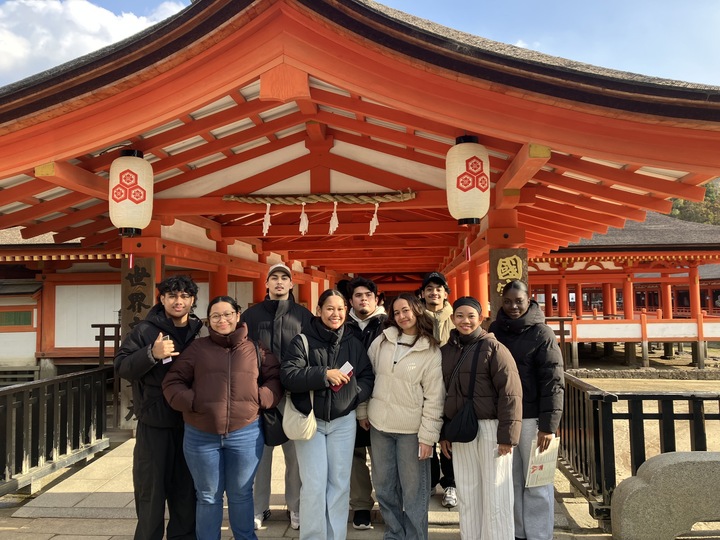
(Right: Ubai)
The goal of the study tour is to deepen the students’ understanding of Japanese society not only through classroom learning, but through first-hand experience- communicating and thinking through local interactions. Students were given the opportunity to further enhance their perception of Japanese society by experiencing history, culture, industry, peace, and the arts while in Hiroshima. Another important goal of the program is to promote mutual understanding and interaction among the students through visiting sites together, eating together, and spending time together throughout the entirety of the program.
Day 1: January 29th
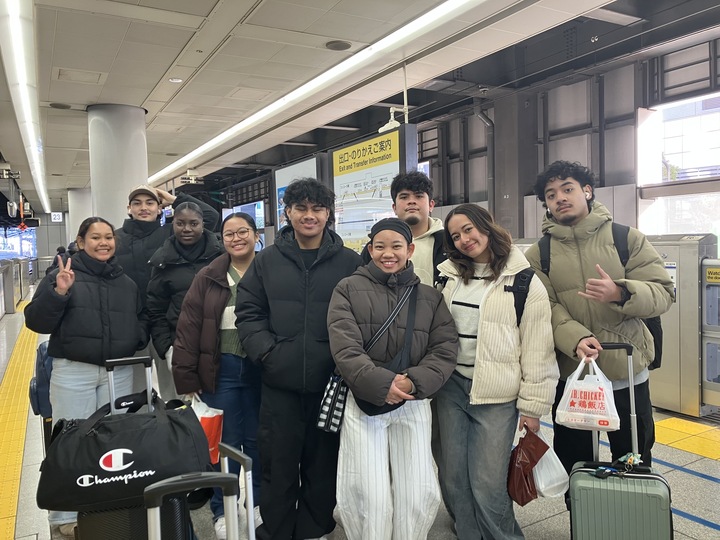
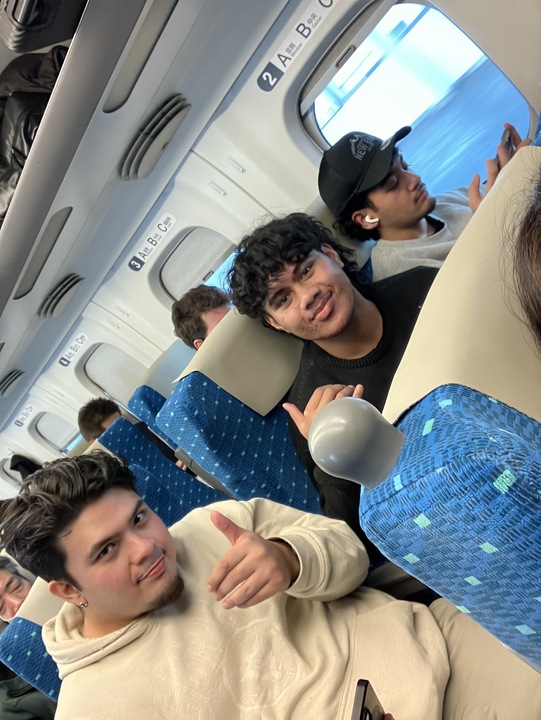
The group left Tokyo for Hiroshima in the early morning of the first day, and partook in cultural and historical training on-site. It was the first bullet train Shinkansen trip for Xavier High School Scholarship student Kreitton and UWI Scholarship student Shonnelle.
Despite the weather in Hiroshima being blustery and cold upon their arrival, the ensuing ferry trip was the first for several of the students, who braved the cold and wind to take photos and videos, visibly enjoying the ride. MCT Scholarship student Luke had visited Hiroshima previously, and he could be heard talking about the good memories from his past visit.
On Miyajima Island, the students visited the famous Itsukushima Shrine and the Treasure Hall, along with the large torii gate. It was the first time for all students to see deer up-close, showing surprise and interest in the free-roaming animals. The group happened to witness a traditional Japanese ceremony taking place at the shrine that day, providing an important chance to see first-hand a Japanese religious ceremony taking place.
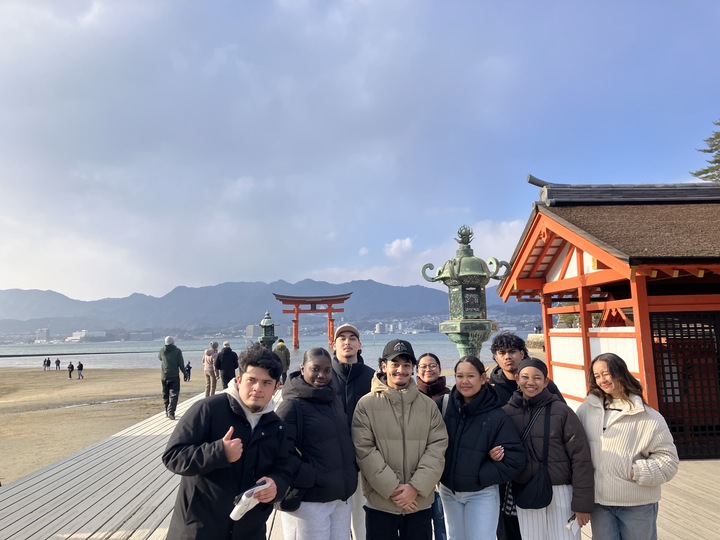
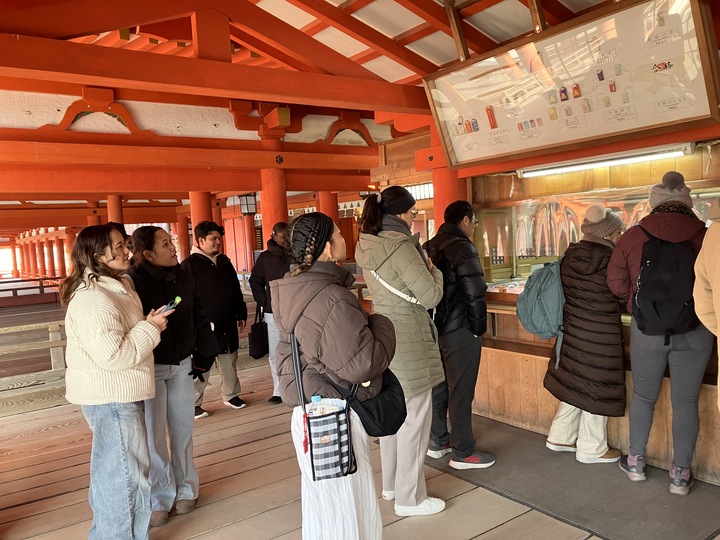
While visiting the Treasure Hall, the students took a particular interest in the traditional costumes as well as architecture drawings from when the torii underwent a large-scale renovation, asking several questions such as the meaning behind the name torii, and how the location of the shrine and torii are decided. MCT Scholarship student Luke brought up the fact that there are similar structures to the Japanese torii in Micronesia; however, unlike the religious aspect that they hold in Japan, these monuments in Micronesia have no such meaning. He showed a deep interest in the torii, continuing to ask questions regarding its meaning and significance. This was a short lesson in comparative cultural studies for the students, deepening their understanding regarding the relationship between Japanese faith and architecture, coming to the conclusion that the torii signify the barrier between the spiritual world and mortals. Dinner that night was Hiroshima-style okonomiyaki at the restaurant Micchan Honten, a restaurant well-loved by locals with a long history. All students thoroughly enjoyed their meal and left with a full stomach and clean plates. Hiroshima-style okonomiyaki was another good opportunity for the students to experience and enjoy local food culture, experiencing first-hand the difference in taste, preparation method, flavors, etc. across the various regions of Japan. Day 2: January 30th
On the second day of the program the students visited companies and industrial facilities within Hiroshima city to learn about Japan’s craftmanship and cleantech industries.
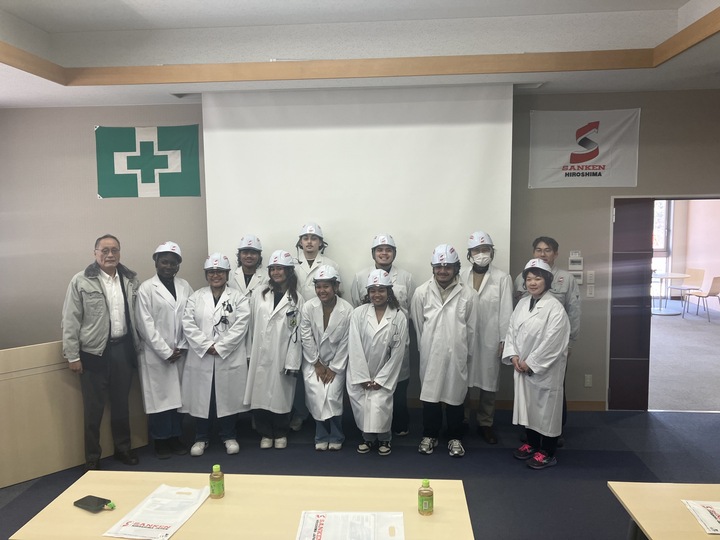
In the morning the group visited Sanken Industrial Furnace, a plant maker which specializes in the total planning, designing, building, and maintenance of industrial furnaces, with partners in over 30 different countries. After the president of the company welcomed the students, they put on white lab coats and helmets and took a tour of the factory as well as the newly built research facility. They received a detailed explanation regarding the manufacturing process of metal parts required for a wide range of industries, including automobiles, electrical components, power plant facilities, ship parts, etc., increasing the students’ knowledge of technologies that support Japan’s industrial infrastructure.
Sanken was also involved in manufacturing the reactors used in JAXA’s H-IIB rocket, piquing the students’ interest in Japan’s high-tech space development industry. Sanken is also aware of its responsibility towards the environment, and is working to cut CO2 emissions from furnaces manufactured in its factories by 2030. The company is conducting research on how to use electricity, hydrogen, and ammonia as fuel alternatives to reach this goal. The visit to the research facility was a good opportunity for the students to witness first-hand furnace test labs, currently developing furnaces, and to learn about the development of technology and environmental conservation.
During the Q&A session, students asked detailed questions, such as enquiring about the shape of the furnaces and the amount of CO2 produced. Two students who are matriculating in the Green Science course offered by the Department of Engineering and Applied Sciences displayed strong interest in potentially interning at Sanken in the near future, actively discussing academic and professional topics. After the tour, the students had lunch at the employee cafeteria, another opportunity to learn about the working environment of Japanese companies.


Day 3: January 31st
The students spent their final day exploring peace, culture, and the arts in Hiroshima city.
The students visited the Hiroshima Peace Memorial Museum in the morning, listening to an English audio guide talk about the events leading up to the bombing, the scope and severity of the aftermath of the attack, and how the city got back on its feet after the fact. The museum provided a good opportunity for the students to learn about the tragedy of war and the value of peace; they spent around 90 minutes walking around the exhibit, listening to actual accounts from survivors, looking at artifacts from the scene, as well as witnessing the damage through photos. Students could be seen spending a good amount of time at each part of the exhibit, with some students staying longer at the more shocking parts of the display.
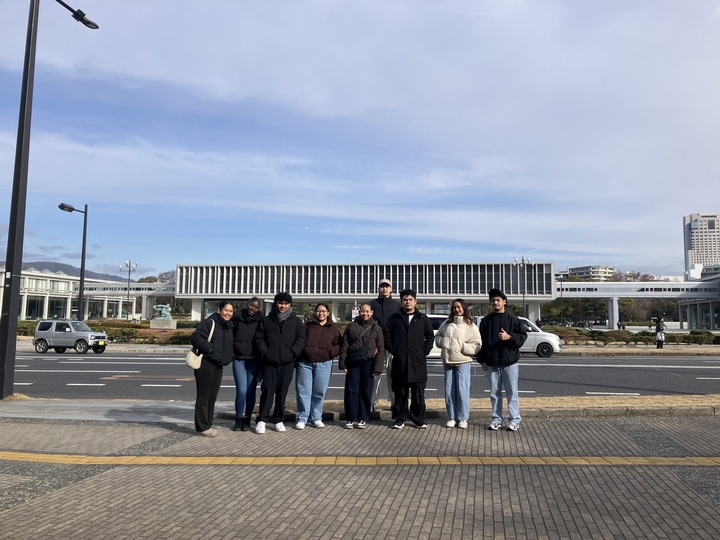
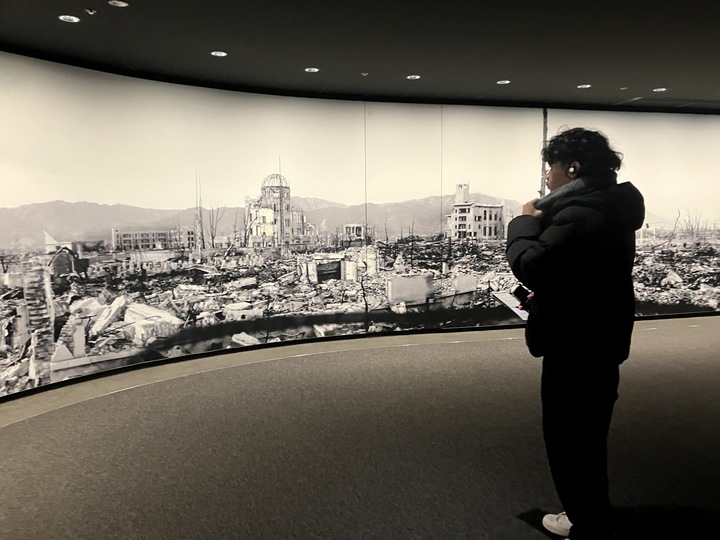
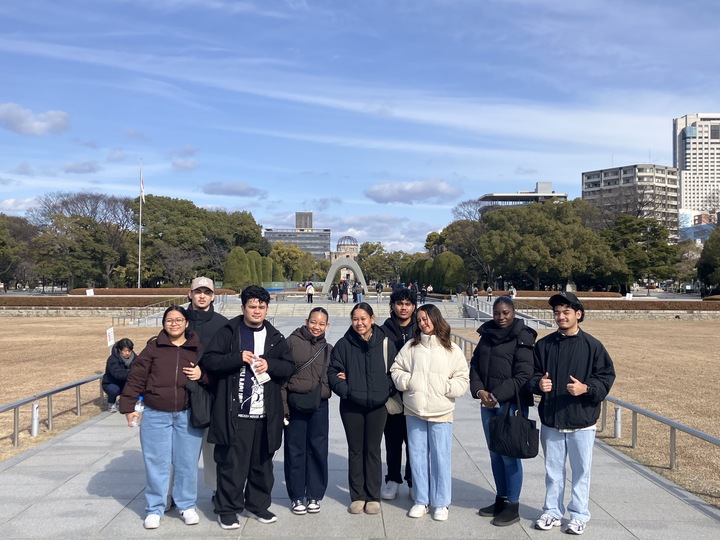
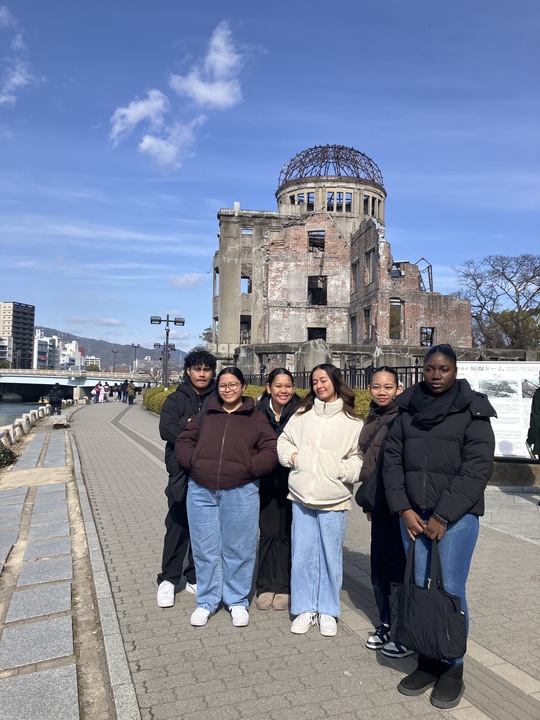
After the museum the group visited the Hiroshima Peace Memorial Park, taking a moment of silence for the victims of the atomic bombing at the Memorial Monument for Hiroshima. Afterward they visited the Atomic Bomb Dome, learning about the reality of the attack through the surviving building. This was another opportunity to think once again about the concept of peace.
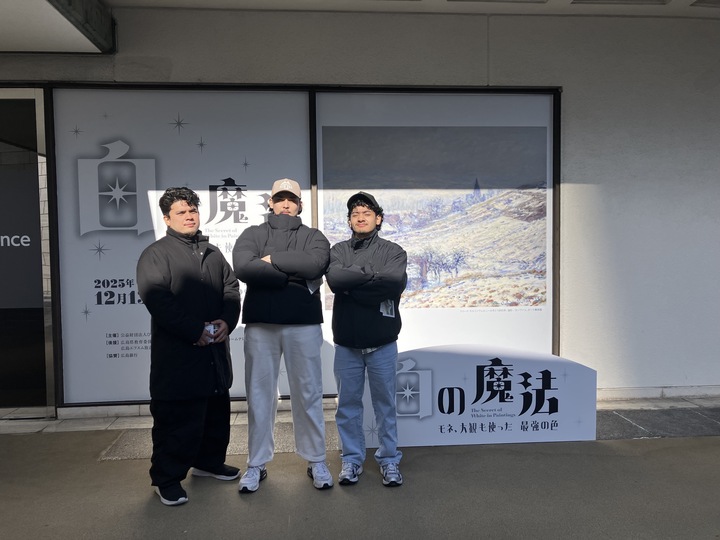
The next stop was a visit to the Hiroshima Museum of Art. The exhibit at the time was “The Magic of White-The Most Powerful Color Used by Monet and Taikan”, displaying numerous paintings by French painter Claude Monet and Japanese painter Taikan Yokoyama, exploring the role and artistic technique of the color white. Students showed a strong interest in how Monet’s white took on different expressions depending on light and amount of application to produce the desired color. The exhibit was unfortunately only in Japanese, so for the students who could not understand Japanese accompanying APIC staff walked with them, translating each part of the exhibit in English.
Results of the Training
This study tour to Hiroshima proved to be a valuable experience for the students, as it provided an opportunity to ponder the meaning of peace, as well as a chance to leave Tokyo and visit local regions, coming into contact with not only world heritage sites but famous tourist spots, allowing the students to interact with Japanese culture and arts.
Another important benefit of this program was the chance for students to socialize with each other outside of the college campus. Students from the same region could be seen talking with each other about differences in food culture; students from different nationalities also discussed differences of their respective food cultures. Students enjoyed spending time with each other after the activities of the day ended, playing card games in their hotel rooms, giving way to natural conversation between all nine of them.
Due to the students living in separate areas and on different floors in the dorm back in Tokyo, the number of opportunities for them to talk and get to know each other are limited; there were students on this trip who had never spoken to each other before setting off for Hiroshima. Against this background, the study tour was a particularly valuable opportunity for the participants, helping to form a solid base for the students to continue to grow their relationships while studying in Tokyo.
WHAT'S NEW
- 2026.6.24 UPDATE
EVENTS
"429th Lecture Meeting Regarding Global Issues"
- 2026.5.27 UPDATE
EVENTS
"428th Lecture Meeting Regarding Global Issues"
- 2026.5.20 UPDATE
PROJECTS
"Pacific & Caribbean Student Invitation Program 2024 Participant Joins Osaka Expo 2025"
- 2026.5.20 UPDATE
SCHOLARSHIP
"10th Term Xavier & 3rd Term UWI Exchange Students Enter Sophia University"
- 2026.5.20 UPDATE
SCHOLARSHIP
"1st Term UWI Exchange Student Graduates Sophia University School (Interview)"
- 2026.5.20 UPDATE
SCHOLARSHIP
"APIC Exchange Students Attend Training in Tamba-Sasayama, Hyogo"
- 2026.5.20 UPDATE
SCHOLARSHIP
"Sixth Term Xavier Exchange Student Graduates Sophia University"
- 2026.5.13 UPDATE
PROJECTS
"Following Up on Janine Emmanuel, Participant of APIC’s Pacific & Caribbean Student Invitation Program"
- 2026.4.21 UPDATE
SCHOLARSHIP
"Welcoming 9th Term Xavier Exchange Students, 8th Term APIC-MCT Exchange Students, and 2nd Term UWI Exchange Students to Sophia University/Graduate School
"
- 2026.4.21 UPDATE
SCHOLARSHIP
"6th Term APIC-MCT Exchange Student Graduates Sophia University Graduate School"